It’s squirrel time! You’ve come across these small creatures in your backyard, the park, or perhaps while camping. But have you ever wondered about the diverse species of squirrels and how to identify them? Let’s dive right in and satisfy that curiosity.
Distinguishing Characteristics of Squirrels
Squirrels, being mammals, share certain common characteristics, but are broadly diversified in features, habits and habitats making identification fascinating. Squirrels can range in size from small chipmunks to large marmots and differentiate greatly in color, from black, grey, reddish-brown to white. Their tails are a standout feature, be it a large bushy tail of a tree squirrel, a tapering tail of the ground squirrel or a broad and flattened tail of a flying squirrel. Each squirrel’s behavior offers another set of clues, from tree-dwelling and arboreal activities, to burrowing and even gliding.
To summarize, keep these key characteristics in mind:
- Size and Body Structure
- Fur color and patterns
- Tail characteristics
- Behavior and Activities
- Habitat
Pro Tip: Early morning and before dusk are the best times to observe squirrels in action. So grab your binoculars and a notebook; you’re about to become a squirrel-spotting expert!
Identifying Tree Squirrels
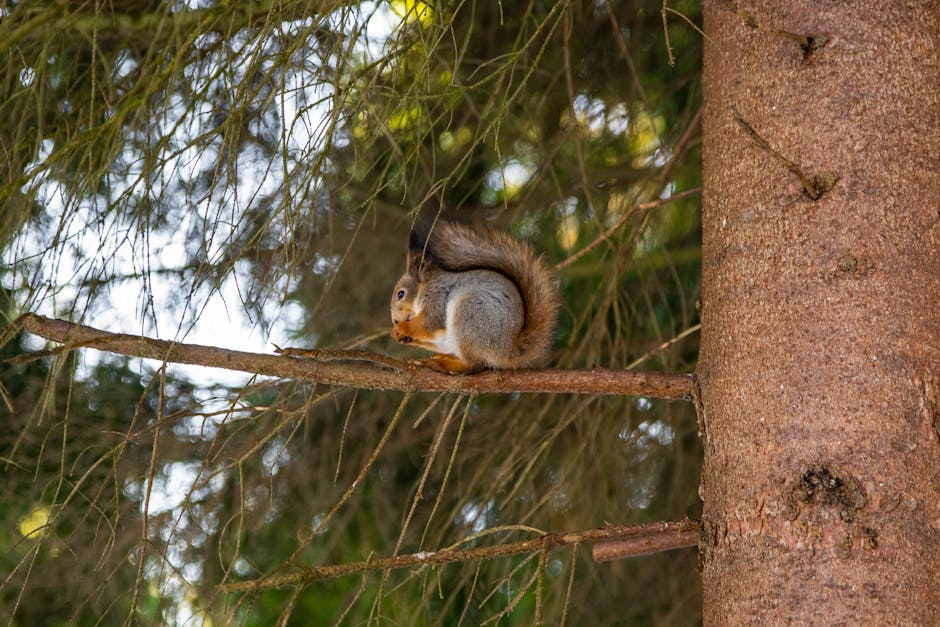
Tree Squirrels, the most familiar types, are accustomed to living in trees (hence the name). Their distinctive long, bushy tails help them maintain balance while navigating the high routes. These agile creatures are predominantly diurnal.
Let’s compare the features of a few common species of tree squirrels:
| Species | Fur color | Tail | Behavior |
|---|---|---|---|
| Eastern Gray Squirrel | Gray, White belly | Long, bushy | Active during the day, good swimmers |
| Fox Squirrel | Brown, Orange belly | Long, fluffy | Active during the day, less tree-dependent |
| American Red Squirrel | Red, White belly | Slightly less bushy | Active during the day, territorial |
Best Practice: While identifying tree squirrels, notice their body size, fur color, and anomalistic behavior, like the smaller red squirrel’s aggressive territorial guarding.
Identifying Ground Squirrels
If you’ve ever mistaken a squirrel for a prairie dog, you were probably looking at a Ground Squirrel. They are adapted for a burrowing life with shorter hair and less bushy tails than tree squirrels. They’re usually about medium-size among the squirrels and exhibit semi-fossorial habits. Some main species of ground squirrels are the Franklin’s ground squirrel and Richardson’s ground squirrel.
Pro Tip: Look out for Ground Squirrels in open grasslands, woodlands, or rocky country. Their burrowing habits often result in noticeable networks of underground tunnels.
Identifying Flying Squirrels
Swooping through the air in the twilight might not be your average squirrel! Flying Squirrels, bearing a soft dense fur, are unique in that they have a patagium – a membrane extending from their neck to their toes, allowing them to glide between trees. These creatures are nocturnal and have large eyes to assist in their nighttime foraging.
Here’s a comparison between Northern Flying Squirrels and Southern Flying Squirrels:
| Species | Fur color | Tail | Behavior |
|---|---|---|---|
| Northern Flying Squirrel | Grayish-brown, White belly | Broad, flat | Nocturnal, non-hibernating |
| Southern Flying Squirrel | Gray, White belly | Broad, flat | Nocturnal, hibernates in harsh winter |
✔️ Checklist for Identifying Flying Squirrels:
- Look out for gliding or ‘flying’ movements between trees.
- Check if the squirrel is active during the night.
- Observe the broad, flattened tail and soft dense fur.
- Note their large eyes and extra skin flaps (patagium).
Identifying Squirrels Based on Geographic Location
Can your location help identify the squirrel species? Absolutely! Each squirrel species tends to have a known geographic distribution. For instance, you’ll only spot a Malabar Giant Squirrel in India and the American Gray Squirrel, as the name suggests, in America.
Here are the squirrel species that are most commonly found in certain areas:
- North America: Eastern Gray Squirrel, Fox Squirrel, American Red Squirrel
- Europe: Red Squirrel, Gray Squirrel (introduced)
- Asia: Malabar Giant Squirrel, Three-striped Palm Squirrel
- Africa: African Pygmy Squirrel, Sun Squirrel
Pro Tip: A squirrel’s geographic location can be a powerful clue in their identification. Research the squirrels native to or introduced in your area before you start your squirrel-spotting adventure!
And there you have it! A comprehensive guide to squirrel identification. So the next time you see a squirrel darting across your path, you’ll be able to know exactly what you’re looking at. Ready to become a squirrel-spotting whiz? Get out there and happy spotting!
Key Takeaway:
- Squirrels can be identified based on distinguishing characteristics like size, fur color, tail features, behavior, and habitat.
- Varieties such as tree squirrels, ground squirrels, and flying squirrels exhibit different traits, behaviors, and habitats.
- Species under each variety, for example, Eastern Gray Squirrel, Fox Squirrel, and American Red Squirrel under tree squirrels, come with unique features and habits.
- Geographic location significantly aids in squirrels’ identification as each species has a known distribution.
Observing and identifying different species of squirrels can develop into an engaging outdoor activity, learning more about biodiversity. Keep in mind to look out for distinguishing traits such as fur color, tail characteristics, behavior, and the habitat they are found in. By using the tips provided, you can sharpen your observation skills and further understand these adorable, energetic creatures.
FAQs
Q: What is a good time to observe squirrels?
A: Early mornings and before dusk are the best times to observe squirrels as they are most active during these periods. Grab your binoculars and head out for some squirrel spotting!
Q: How can I distinguish between a tree squirrel and a ground squirrel?
A: Tree squirrels usually have large bushy tails and spend most of their time in trees. On the other hand, ground squirrels have less bushy tails, shorter hair and are more accustomed to open grasslands and woodlands.
Q: Is it true that flying squirrels can actually fly?
A: Flying squirrels cannot fly like birds. They have a membrane called patagium that extends from their neck to toes enabling them to glide between trees. They seem like they are flying which is why they are termed as ‘flying’ squirrels.
Q: Are squirrels nocturnal?
A: Most squirrel varieties such as tree and ground squirrels are diurnal, meaning they are active during the day. However, flying squirrels are nocturnal and are most active during the night.
Q: Can squirrels’ geographic location be used for their identification?
A: Absolutely! Each squirrel species tends to have a known geographic distribution and hence, their location could serve as a significant clue in their identification.
Happy squirrel-spotting! Feel free to share this article with family and friends who might be interested in identifying squirrels. For more interesting posts, don’t forget to explore our website.